Marbury vs. Madison
George Washington was not a fan of political parties. He thought partisanship would burden the potential to rule. However, the first political separation emerged within his cabinet. Thomas Jefferson, the Secretary of State, began voicing strong opinions about how the government should function, particularly in economic policies, foreign relations and relations with the states. Thomas Jefferson came to lead the Democratic-Republicans, while Alexander Hamilton, Washington’s Treasury Secretary, held strong for the opposing views of the Federalists. See more history and the main political differences here.
The first contested election came when George Washington refused a third term. John Adams, Washington’s Vice President and a Federalist, took the win. But after a 4-year term, the Democratic-Republicans grabbed the reins.
This case arose during the turnover between Adams and Jefferson.
The Adams appointments
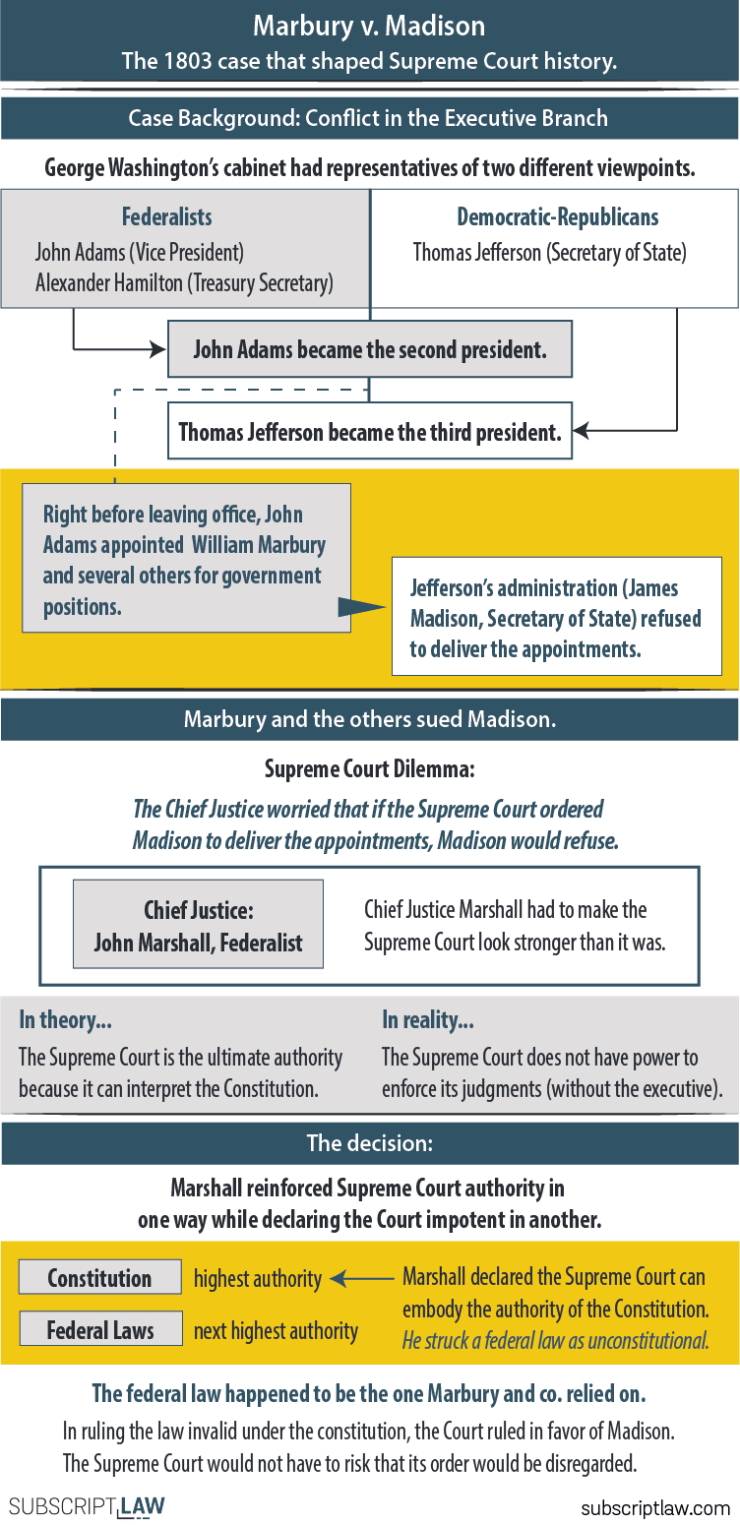
Right before Adams was to leave office, he appointed several people into government positions. William Marbury was one of them. The appointments were not formally delivered before the Presidential turnover, so it would be Jefferson with the responsibility. Given the political differences, Jefferson refused.
The case
Marbury and the others who were refused their appointments sued directly in the Supreme Court. They asked the Court to issue a “writ of mandate” – a demand – for the new Secretary of State, James Madison, to get it done.
What, in theory, is a “demand”? A demand is a request with a degree of authority. But the authority of the Supreme Court is based on the threat of executive power. Marbury was asking the Court to issue a command against the highest executive authorities – the same authorities responsible for enforcing court orders in the first place.
Judiciary, the apolitical branch
The Court was created to be the apolitical branch. Intentionally so, the judges don’t have to worry about re-appointment or re-elections; their salaries cannot be diminished. These features are meant to keep courts away from political influence.
However, this case highlighted a significant dependence of the judiciary. It was a weakness that allowed politics to creep into the Court’s decision.
John Marshall, the Chief Justice of the Supreme Court, recognized this issue of enforcement. He did not want the Supreme Court to look weak. Remember, in the early days of the nation, the power of the three branches had no precedent. The system of checks and balances hadn’t even been proven effective. Marshall could not let the judiciary fall.
Rock, paper, scissors
Rock can’t beat paper, but it can pound scissors.
Knowing the judiciary could not win against the executive, Marshall (writing for the Supreme Court) decided to declare Court authority over the legislative branch. Never before had the Supreme Court used the Constitution to overrule Congress, but this day it did.
Marbury’s argument depended on an act of Congress (aka a federal law). The provision Marbury and co. cited was one giving the Supreme Court authority to issue the “writ of mandate.” That provision would become the sacrificial lamb.
Writing for the Court, the Chief Justice declared the provision unconstitutional. The Court said the Supreme Court might have authority to deliver “writs of mandate,” but not in cases brought directly to the Supreme Court (which the federal law purported to allow). The Supreme Court’s “original jurisdiction” was limited in the Constitution: to “Cases affecting Ambassadors, other public Ministers and Consuls, and those in which a State shall be Party.” Anything else (writs of mandate) would have to start in the lower courts.
In one fell swoop, the Court declared itself powerless in ordering the appointments yet eternally powerful over acts of Congress. The power of Congressional review is the legacy of Marbury v. Madison, a Supreme Court ingrained power today.
Should we be suspicious of Court modesty?
Since Marbury v. Madison, the Supreme Court has declared itself powerless in a handful of contexts. One of these contexts is suspicious: “cases raising political questions.” In these cases, the Court claims a question is too political for it to make a decision. Decide for yourself whether you think that excuse is a cop-out: Review a political gerrymandering case of this term: Gill v. Whitford.
Baker vs.Carr
Baker v. Carr, (1962), U.S. Supreme Court case that forced the Tennesseelegislature to reapportion itself on the basis of population. Traditionally, particularly in the South, the populations of rural areas had been overrepresented in legislatures in proportion to those of urban and suburban areas. Prior to the Baker case, the Supreme Court had refused to intervene in apportionment cases; in 1946 in Colegrove v. Green the court said apportionment was a “political thicket” into which the judiciary should not intrude. In the Baker case, however, the court held that each vote should carry equal weight regardless of the voter’s place of residence. Thus the legislature of Tennessee had violated the constitutionally guaranteed right of equal protection(q.v.). Chief Justice Earl Warrendescribed this decision as the most important case decided after his appointment to the court in 1953.
Citing the Baker case as a precedent, the court held in Reynolds v. Sims(1964) that both houses of bicameral legislatures had to be apportioned according to population. It remanded numerous other apportionment cases to lower courts for reconsideration in light of the Baker and Reynolds decisions. As a result, virtually every state legislature was reapportioned, ultimately causing the political power in most state legislatures to shift from rural to urban areas.
 sheephatepolitics